

A single full-face HIFU session can cost as much as the device that does it at home. Here is what HIFU lifting actually does, how the Dualsonic Optimum brings it to your bathroom, and why owning the machine often costs the same as one or two clinic appointments.
In short
- HIFU (high-intensity focused ultrasound) heats tiny points beneath the skin to encourage new collagen. That is where the lifting and tightening comes from.
- The Dualsonic Optimum is a dual-layer HIFU device for home use. It works at six depths from 1.5 mm to 4.5 mm, the same depth clinics aim for in the lifting layer.
- At €1,450 / $1,450, it costs less than one Ultherapy session in the US and about the same as one or two full-face HIFU sessions in the UK, Germany and France.
- It has unlimited shots and no cartridges, so once you own it, there’s nothing left to pay per session.
What is HIFU, and why does it lift?
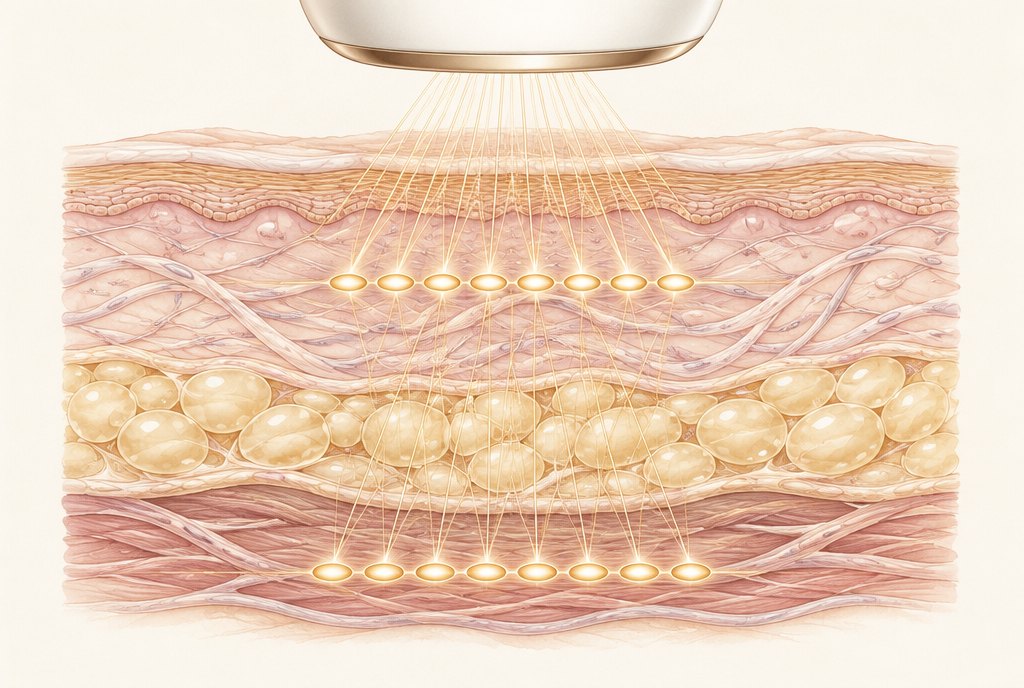
HIFU stands for high-intensity focused ultrasound. A transducer focuses ultrasound energy into small points at a set depth beneath the skin, the way a magnifying glass focuses sunlight. The skin surface stays intact. Below it, each focal point briefly heats the tissue enough to set off the skin’s own repair response.
That repair response is what matters. Over the following weeks the skin makes new collagen and elastin (neocollagenesis) and the existing collagen fibres contract. Collagen is what keeps skin firm, and we make less of it every year from our mid-twenties. HIFU prompts the skin to start rebuilding it.
This is why HIFU has become the best-known non-surgical facelift. There are no needles, no incisions and no downtime. Results build gradually rather than appearing overnight.
Lifting vs tightening: two depths, two effects
The words get used interchangeably, but they describe different layers:
- Lifting happens deep, around 4.5 mm, at the SMAS (superficial musculo-aponeurotic system). This is the fibrous support layer a surgeon tightens in a facelift. Working at this depth is what redefines the jawline and softens jowls.
- Tightening happens higher up, in the dermis, at roughly 1.5–3.0 mm. Here, new collagen improves firmness, crepiness and fine lines, especially around the eyes, brows and neck.
The Dualsonic Optimum: dual-layer HIFU at home
The Dualsonic Optimum focuses on one thing: HIFU lifting. There’s no RF and no microcurrent here, just dual-layer focused ultrasound with LED support, in a 320 g handheld that sits in its own charging cradle.
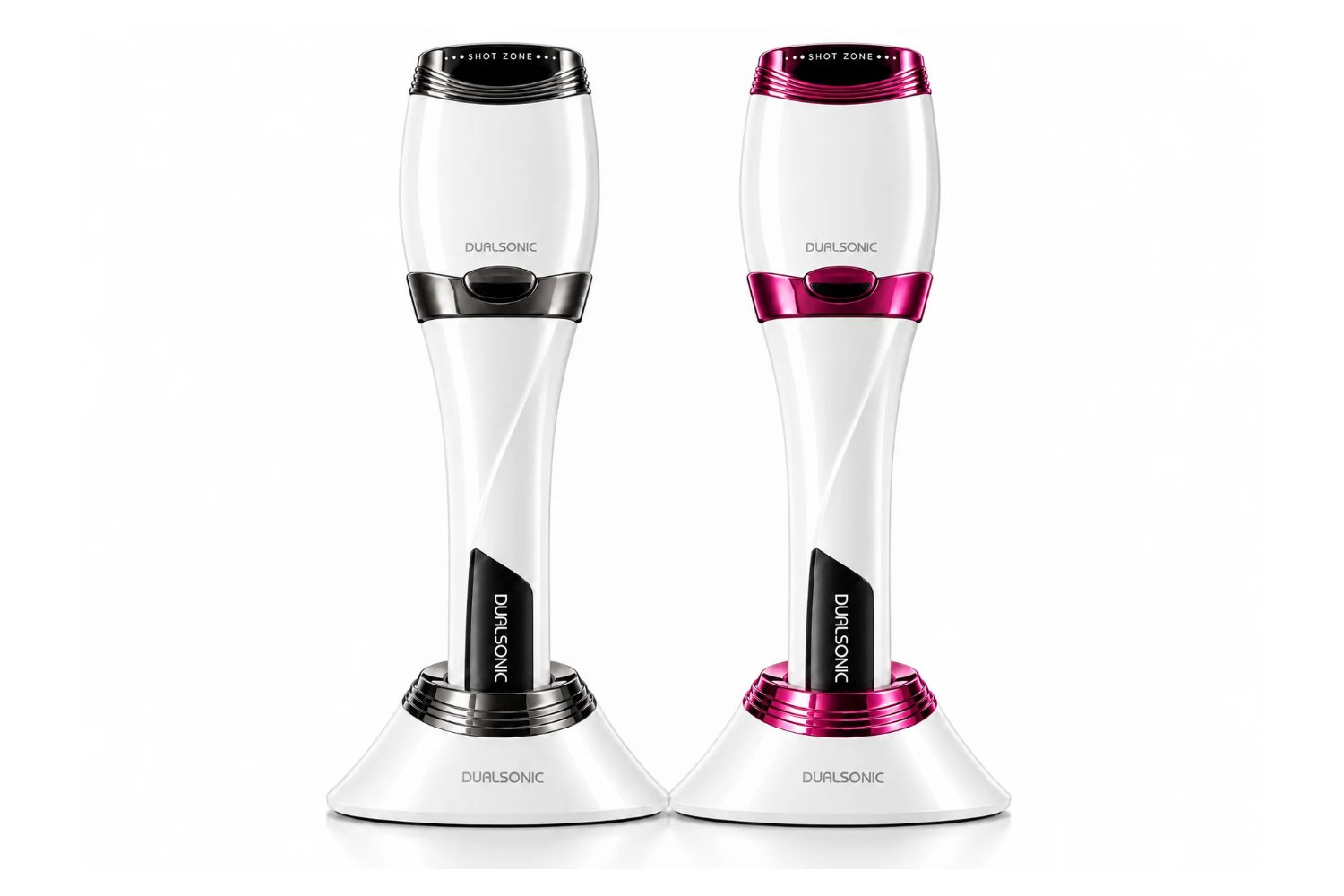
What it does, in numbers
- Dual-layer HIFU treats two depths with every shot.
- Six depths: 1.5, 2.0, 2.5, 3.0, 3.5 and 4.5 mm.
- 13-dot line shots at 7 MHz.
- Three LED wavelengths: red, yellow and infrared.
- Unlimited shots with no replacement cartridges.
- Warranty: 1 year or 200,000 shots, whichever comes first. CE and KC certified.
Six modes, each matched to a zone
| Mode | Depth | Shots | Best for |
|---|---|---|---|
| Quick Mode | Full routine | 200 · about 6 min | Weekly face, eye and brow routine |
| V-up | 3.5 + 4.5 mm dual | 50 | Jawline, jowls, V-line contour |
| Face-up | 2.5 + 3.0 mm dual | 100 | Cheeks, overall firmness |
| Eye-up | 1.5 mm | 50 | Crow’s feet, crepey under-eye skin |
| Brow-up | 1.5 + 2.0 mm dual | 50 | Brow lift, forehead lines |
| Neck-up | 2.0 mm | 50 | Neck lines, crepey neck skin |
Want the full ritual rather than one zone? Quick Mode covers face, eyes and brows in about six minutes, once a week.
Dualsonic Optimum
Dual-layer HIFU at home · unlimited shots · Ruby or Ash
What HIFU costs at a clinic, country by country
Clinic prices depend on the city, the machine (Ultherapy, Ultraformer or a generic HIFU platform) and how many zones are treated. These are typical published prices for a single full-face session in 2026:
| Country | One full-face clinic session | The Optimum equals… |
|---|---|---|
| United States | $2,500–$4,500 (Ultherapy, full face) $2,300–$5,500 (face and neck) | Less than one session |
| United Kingdom | £600–£2,500+ at premium London clinics £200–£500 for medical-grade high-street HIFU | One to two premium sessions (≈ £1,250) |
| Germany | €700–€900 full face €900–€1,000 face and neck | About two sessions |
| France | €600–€1,500 full face | One to two sessions |
| Spain & Italy | About €280–€300 on average €400–€600 at premium Barcelona clinics | Three to five sessions, or about two years of maintenance |
Dualsonic Optimum: €1,450 / $1,450. The UK figure is converted at €1 ≈ £0.86 (September 2026). Clinic ranges are drawn from published 2026 price guides; see the sources at the end of this article.
The real difference: a session vs a routine
A clinic price buys you one appointment. Most clinics then suggest a follow-up session and yearly maintenance, because collagen keeps declining with age. So the true cost is a recurring one.
Owning the device changes that:
- There’s nothing to pay per session. Unlimited shots and no cartridges mean the price you pay is the whole cost.
- The cost per treatment keeps falling. Used weekly in Quick Mode, the Optimum works out at about €28 per session in year one and about €9 per session over three years.
- You treat when it suits you. There’s no booking, no travel and no waiting room. A six-minute routine fits into an evening at home.
- Your household can share it. Clinic sessions are for one face. The device isn’t.

What to expect, honestly
A home device isn’t a clinic machine in miniature. A clinic machine delivers more energy per session. A home HIFU device uses gentler energy more often, and the collagen builds up over weeks instead of in one appointment. Think of it as the difference between a single strong treatment and a steady routine. The routine suits people who want to keep results going rather than chase them once a year.
- Weeks 1–4: skin feels firmer and looks brighter. This is mostly the tightening effect in the dermis.
- Weeks 4–12: collagen remodelling builds. This is when changes to the jawline and contour usually become visible.
- After 12 weeks: maintenance. Keep a weekly Quick Mode routine and add zone modes where you want extra focus.
Results vary from person to person. They depend on age, skin quality, lifestyle and how consistently you use the device. For a fuller, evidence-based look at what home devices can and can’t do, read Do at-home HIFU devices actually work?

Who should not use HIFU at home
Don’t use the device during pregnancy, over open wounds, active acne or skin infections, or over metal or electronic implants (including pacemakers). Also avoid areas with recent fillers or threads. If you have a medical condition or are unsure, check with your doctor first, and always follow the user manual.
Optimum or Maximum Alpha?
Choose the Optimum if your priority is lifting and tightening, and you want pure dual-layer HIFU with nothing extra. Choose the Maximum Alpha if you’d also like RF, microcurrent and electroporation in the same device, for texture, glow and serum absorption. For a full side-by-side, see Dualsonic Professional vs Maximum Alpha. For the cost math over several years, read HIFU at home vs a clinic: what each one really costs.
Frequently asked questions
Does at-home HIFU really lift the skin?
HIFU works by stimulating collagen at set depths. The Optimum reaches 4.5 mm, the SMAS-level depth that clinical lifting aims for. Home devices use lower energy than clinic machines, so results build gradually with regular use over 8–12 weeks rather than after a single session.
How often should I use the Dualsonic Optimum?
Use Quick Mode, a roughly six-minute face, eye and brow routine, once a week. Zone modes such as V-up or Neck-up follow their own guidance in the user manual.
Is the Dualsonic Optimum cheaper than clinic HIFU?
At €1,450 / $1,450, it costs less than one full-face Ultherapy session in the US, and about the same as one or two full-face HIFU sessions in the UK, Germany or France. It has unlimited shots and no cartridges, so there is no further cost per session.
Does HIFU hurt?
Most people feel warm, prickling pulses at the deeper depths, especially along the jawline. The shallower eye and brow depths are gentler. Use gel and move steadily across the skin.
What is the difference between HIFU lifting and tightening?
Lifting targets the deep SMAS layer, at around 4.5 mm, to redefine contour and jawline. Tightening targets the dermis, at 1.5–3.0 mm, to improve firmness and fine lines. Dual-layer HIFU does both in the same shot.
Do I need to buy cartridges?
No. The Optimum has unlimited shots and no replaceable cartridges. It is covered for 1 year or 200,000 shots, whichever comes first.
Clinic-depth HIFU lifting at home, for the price of one or two clinic sessions.
Shop Dualsonic OptimumSources for clinic prices (2026): US: Thervo Ultherapy cost guide; AestheticMedGuide Ultherapy cost guide. UK: Georgina Sookias, How much does HIFU cost in London? 2026 price guide. Germany: Dermacom, HIFU-Behandlung Kosten. France: Prix HIFU en France 2026, liftingsanschirurgie.com. Spain: Multiestetica HIFU price index. Italy: Guidaestetica HIFU price index. Prices are indicative and vary by clinic, city and treated area.
The Dualsonic Optimum is a cosmetic device for home use. It is not intended to diagnose, treat or cure any medical condition.